BACKLASH:
A QUEER CULTURAL STATE OF THE NATION
RESEARCH HIGHLIGHTS:
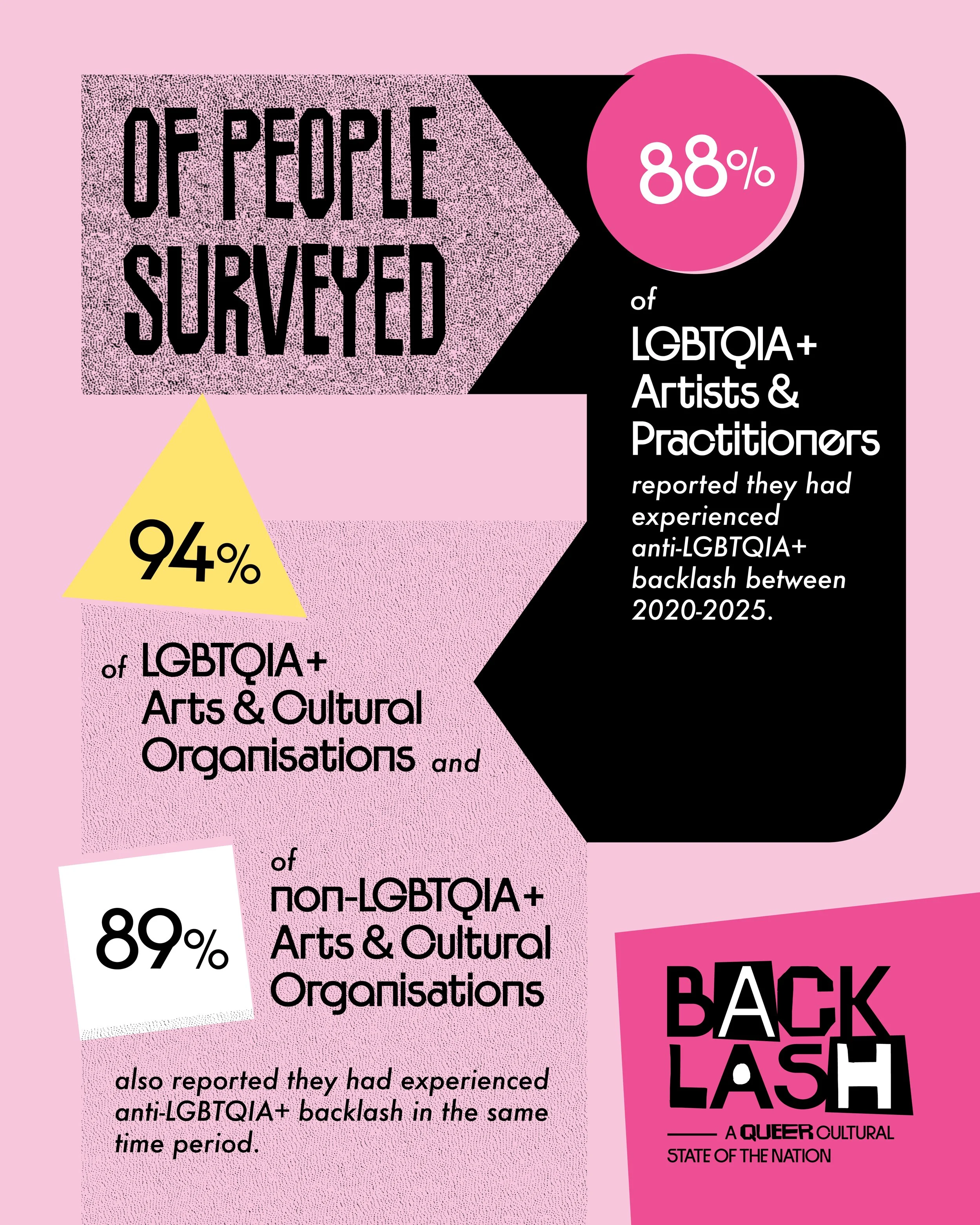
Documenting and understanding experiences of backlash currently being received against LGBTQIA+ cultural programming and/or creatives in the UK’s cultural sector from 2020-2025.
DOWNLOAD OUR FULL RESEARCH HIGHLIGHTS SUMMARY DOCUMENT INCLUDING KEY STATISTICS USING THE LINK BELOW
INTRODUCTION:
We are facing a moment of crisis for LGBTQIA+ Arts and Culture in the UK
This page shows the key findings of new research conducted by the LGBTQIA+ Cultural Barometer detailing experiences of backlash against LGBTQIA+ programming and/or creatives in the UK’s cultural sector between 2020–2025.
The LGBTQIA+ Cultural Barometer is an independent research project investigating the current climate for making and presenting LGBTQIA+ programming in the UK’s cultural sector, and to contextualise, evidence, and measure the experiences of backlash we have been receiving. Our research shows a stark national picture of widespread anti-LGBTIQIA+ backlash against cultural programming, organisations, and creatives across the UK between 2020 and 2025. Further, it reveals the often devastating impact of these experiences and recognises numerous coordinated attempts to dismantle the infrastructures that support UK LGBTQIA+ culture.
The LGBTQIA+ Cultural Barometer has been led by Curious Arts in partnership with Fatt Projects and Marlborough Productions and in collaboration with trans researcher Chloe Turner, with funding from Arts Council England. The project is a response to: our collective experiences of backlash; reports of similar experiences from artists, colleagues, and partners in our networks; rising community tensions and increasing levels of queerphobia and transphobia; evolving legal framework governing LGBTQIA+ people; growing demand for support from voices across the sector.
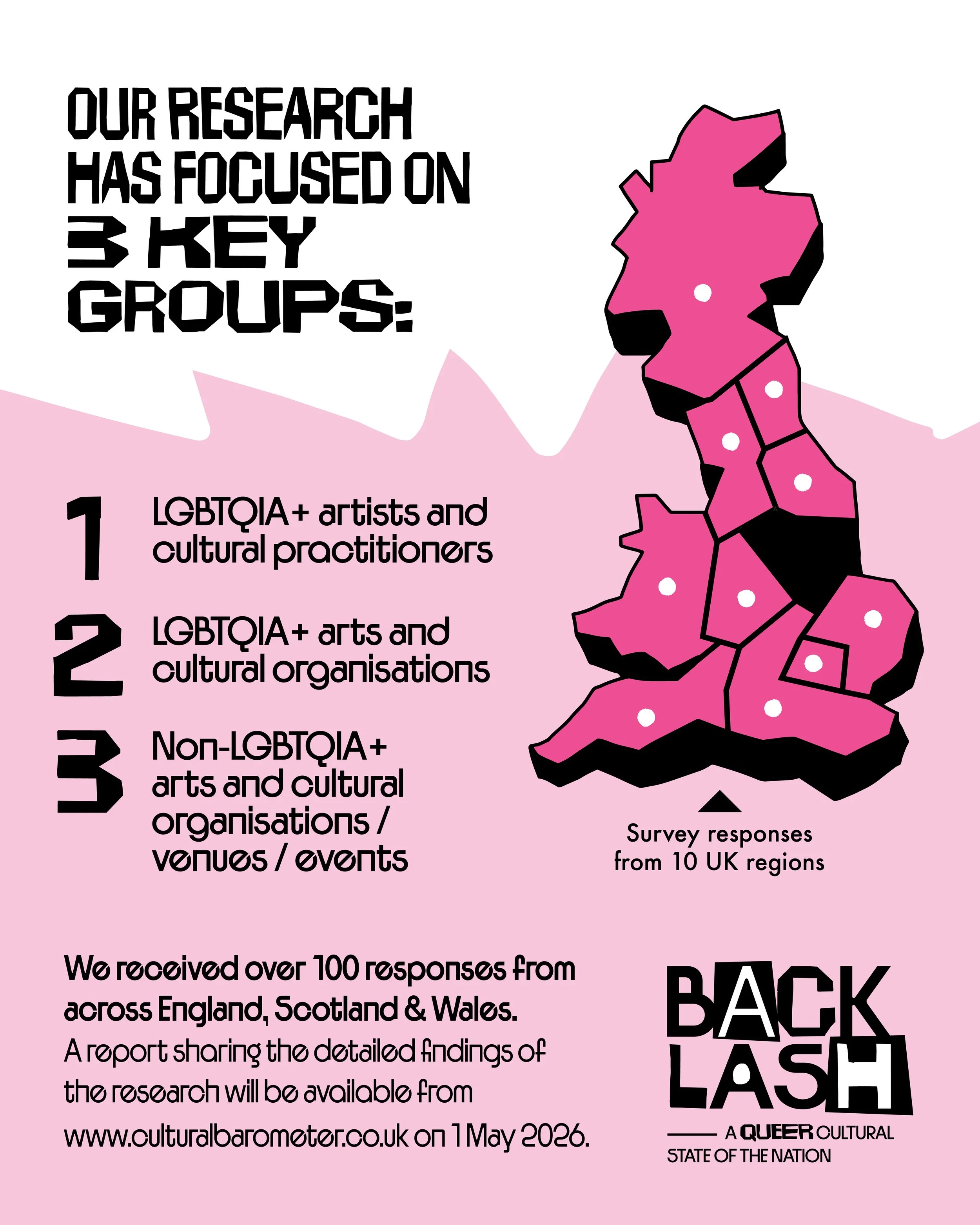
Our research collected data from individuals and organisations across the UK and conducted an in-person focus group with representatives from 12 LGBTQIA+ led cultural organisations. Our research has focused on 3 key groups:
LGBTQIA+ artists and cultural practitioners (58 responses) working across performance, visual arts, media, and academia.
LGBTQIA+ arts and cultural organisations (16 responses) including producing organisations; advocacy groups; festivals; and arts, youth, and heritage charities.
Non-LGBTQIA+ arts and cultural organisations/venues/events (27 responses) from the arts, heritage, public, and third sectors.
We received over 100 responses from across England, Scotland & Wales.
A full report sharing the detailed findings of the research will be available from www.culturalbarometer.co.uk on 1 May 2026.
A glossary of key project definitions can be found here.
This research provides a snapshot into an ongoing and intensifying situation. In the last month of delivering this project, our organisations have experienced in-person protests at events, local councils attempting to remove funding from our partner venues (albeit unsuccessfully), and community participants in our work being targeted, doxed, and harassed by prominent far-right leaders outside their homes.
It is clear to us that we are in a national moment of crisis for LGBTQIA+ culture and communities, the question now is how do we meet it?
Adam Carver (they/them)
Project Manager, LGBTQIA+ Cultural Barometer
WHAT EXAMPLES OF BACKLASH ARE BEING REPORTED?
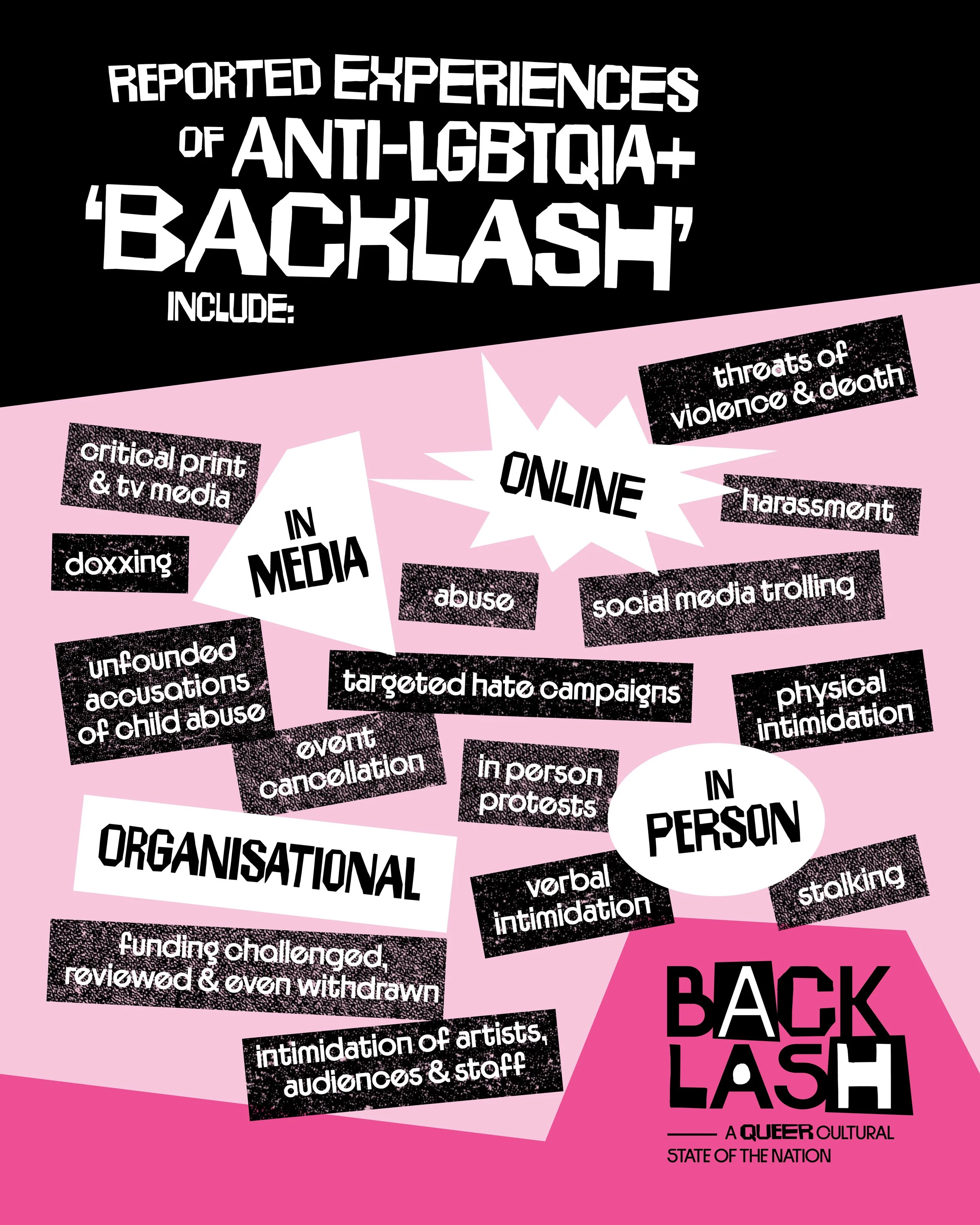
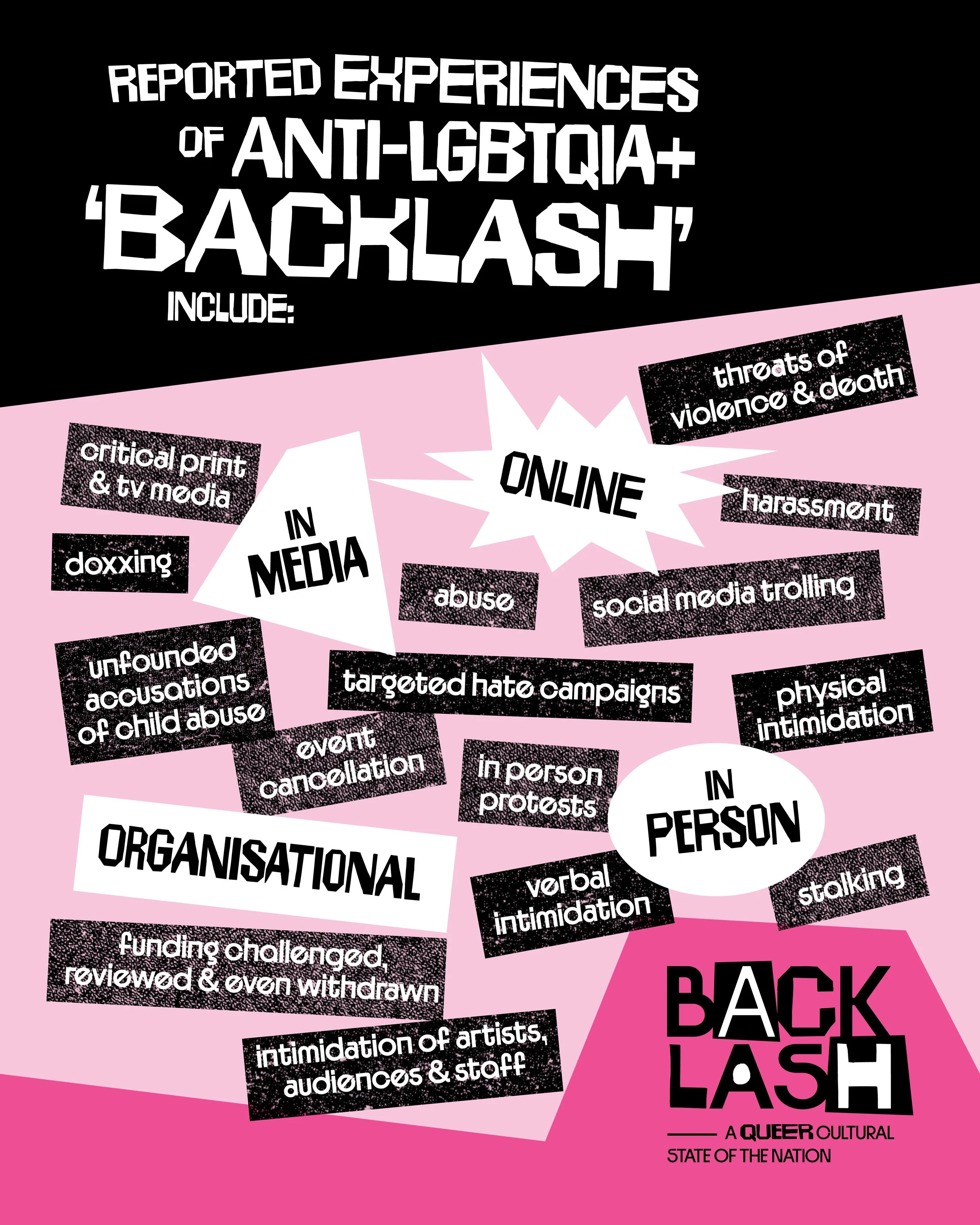
ONLINE, IN MEDIA, IN PERSON & ORGANISATIONALLY
Including:
targeted hate campaigns, social media trolling, doxxing.
critical print & television media.
Unfounded accusations of child abuse.
Verbal intimidation, harassment, abuse & threats of violence & death.
Physical intimidation, harassment, stalking, & intimidation of artists, audiences and staff.
In person protests.
Event cancellation.
Funding challenged, reviewed, and even withdrawn
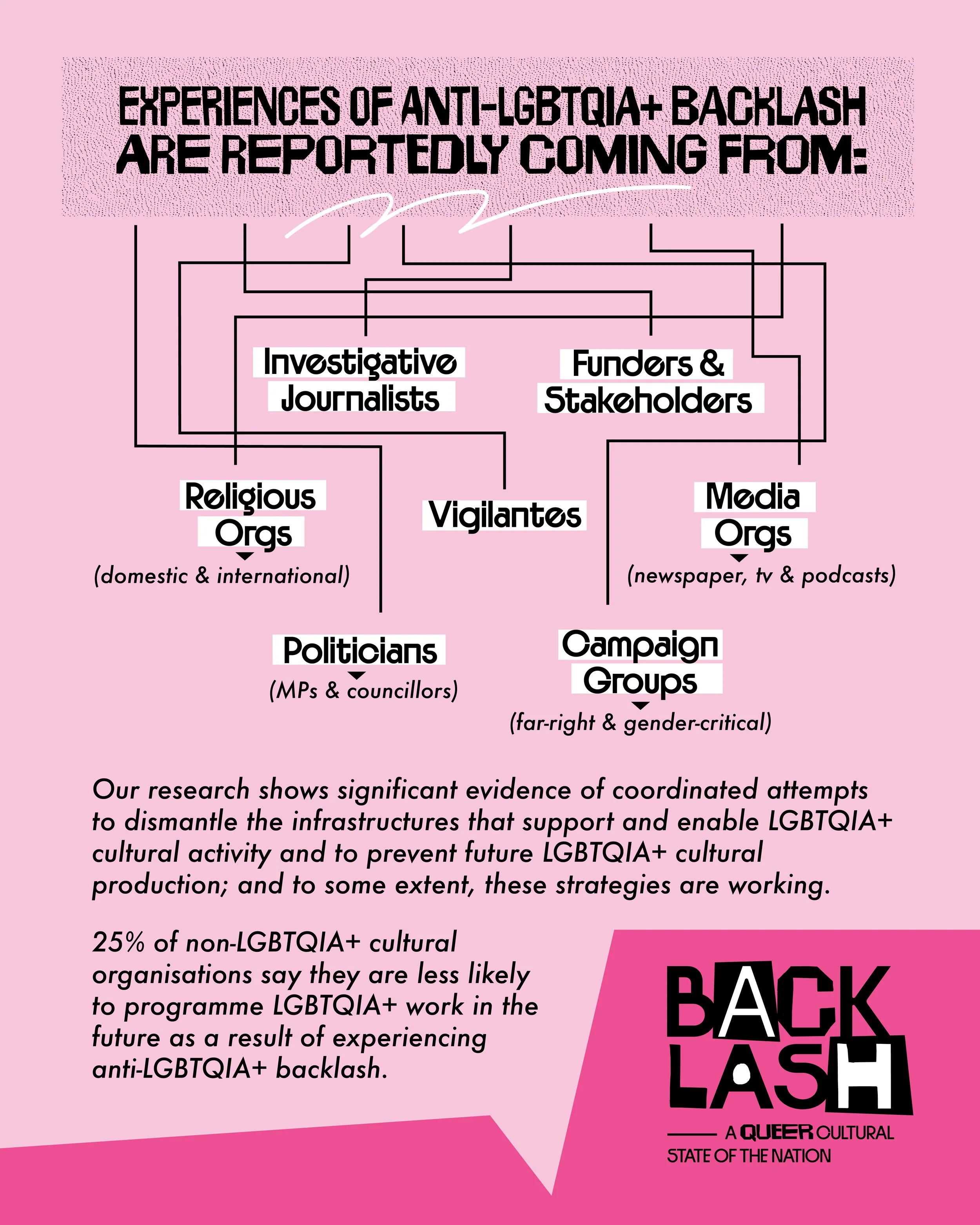
WHO IS DOING THIS?
Campaign groups (Far-Right, Gender-Critical)
Religious organisations (domestic and international)
Politicians (MPs and councillors)
Vigilantes
Investigative journalists
Media orgs (TV, newspapers, podcasts)
Funders/stakeholders
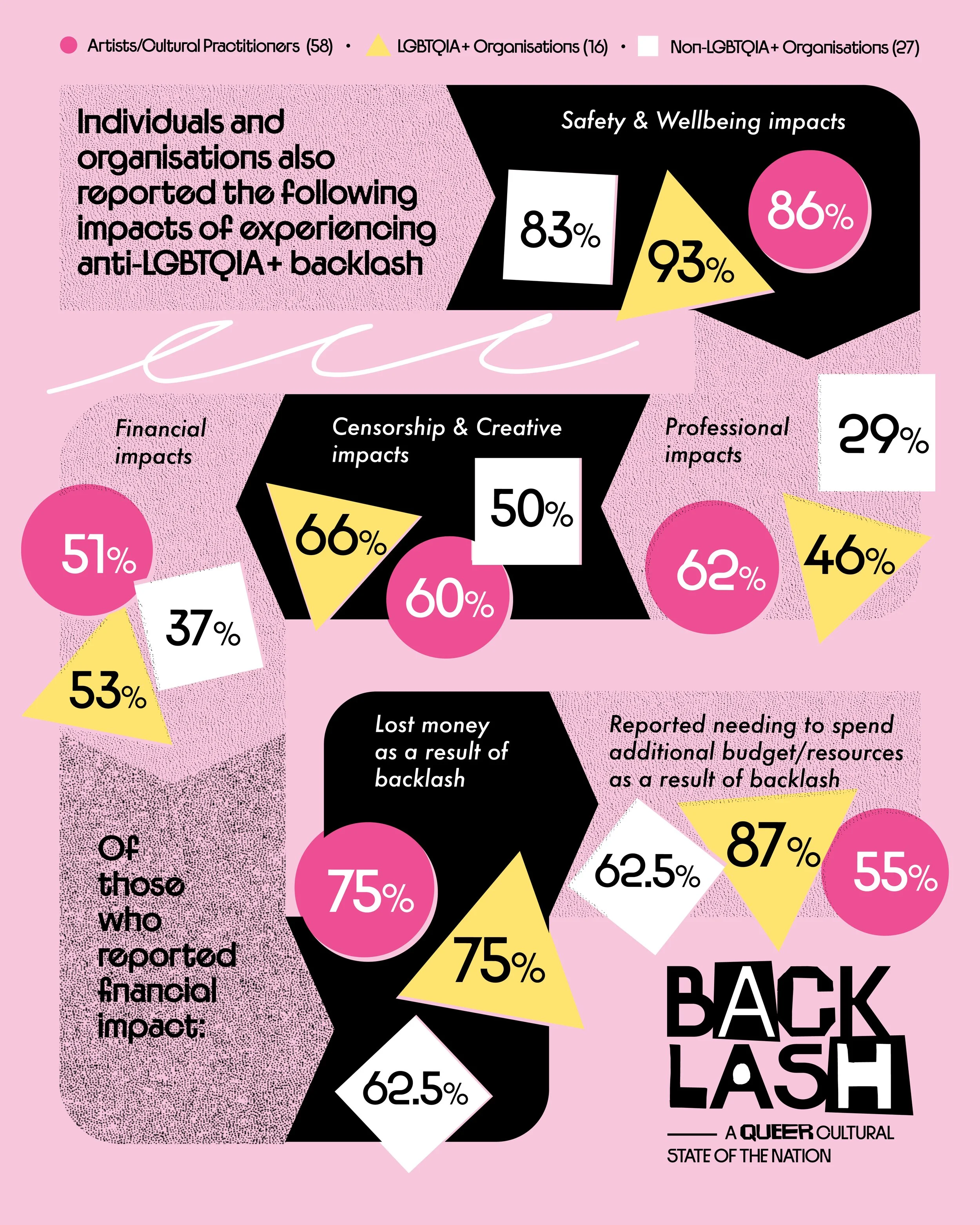
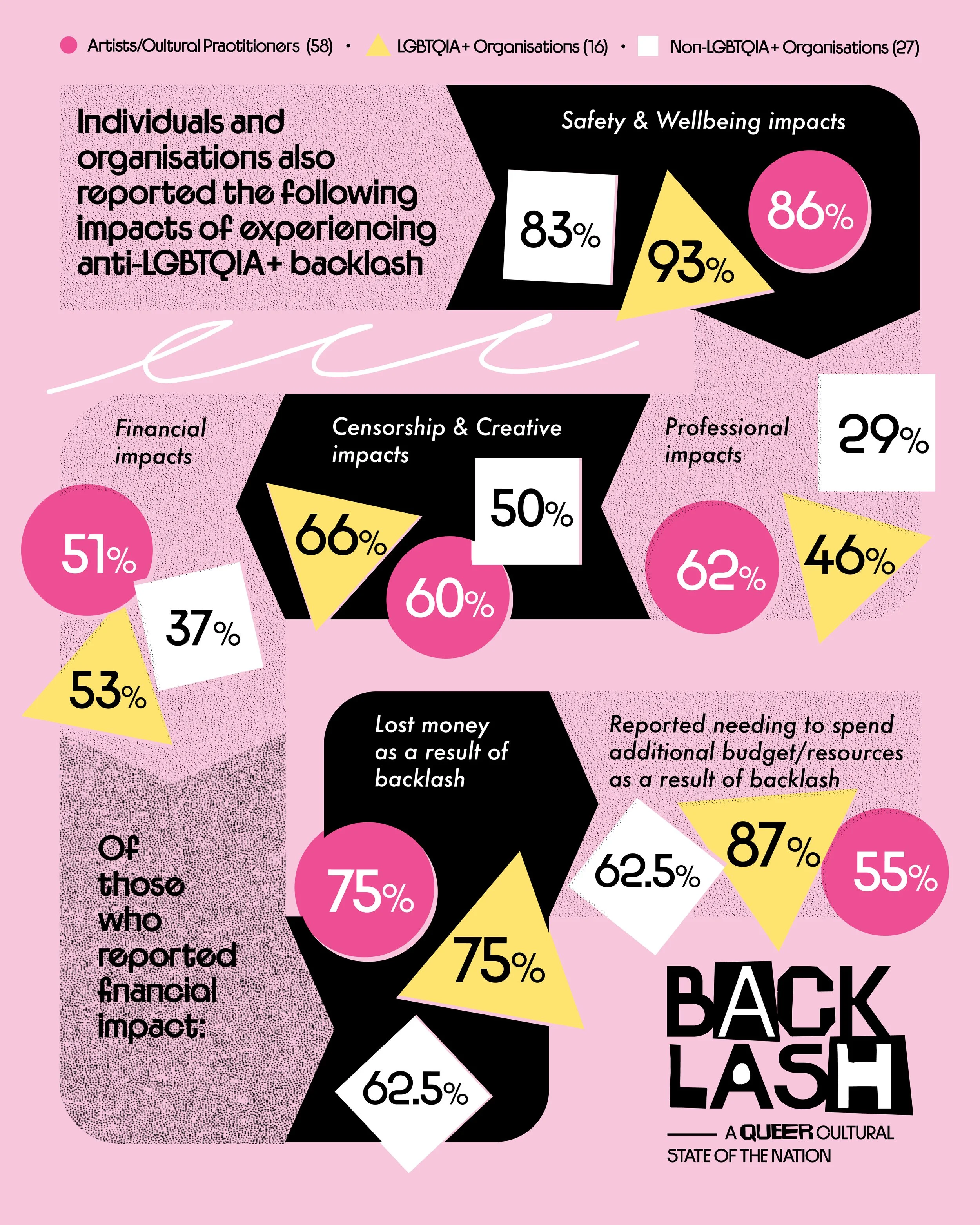
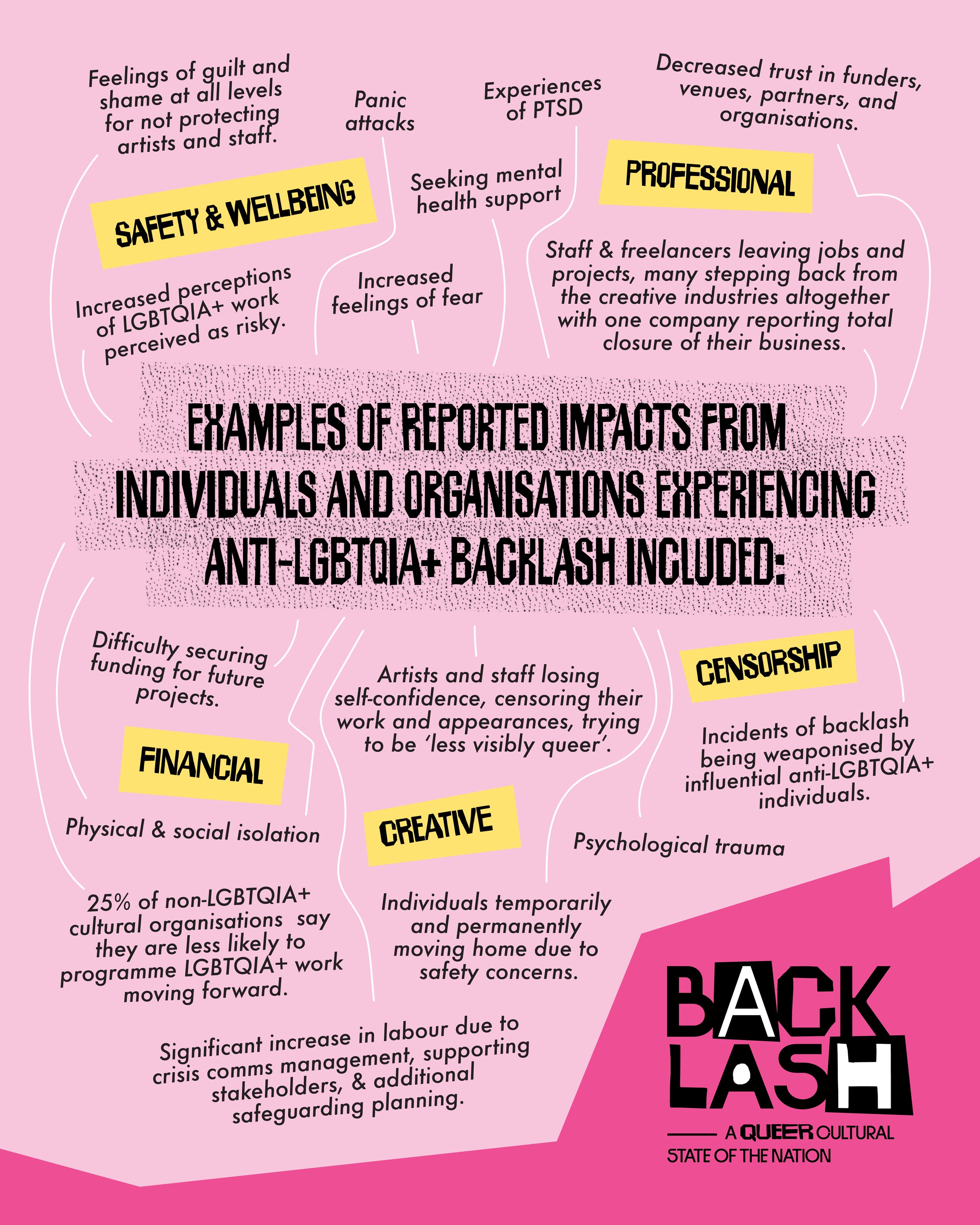
THE IMPACTS OF THIS ON INDIVIDUALS AND ORGANISATIONS INCLUDE:
SAFETY & WELLBEING | PROFESSIONAL | FINANCIAL | CREATIVE | CENSORSHIP
including:
experiences of PTSD & psychological trauma, panic attacks, seeking mental health support, therapy and increased feelings of fear, physical and social isolation.
Feelings of guilt and shame at all levels for not protecting artists and staff.
Staff & freelancers leaving jobs and projects, many stepping back from the creative industries altogether with one company reporting total closure of their business.
Individuals temporarily and permanently moving home due to safety concerns.
Difficulty securing funding for future projects.
Decreased trust in funders, venues, partners, and organisations.
Increased perceptions of LGBTQIA+ work perceived as risky.
25% of non-LGBTQIA+ cultural organisations say they are less likely to programme LGBTQIA+ work moving forward.
Significant increase in labour due to crisis comms management, supporting stakeholders, & additional safeguarding planning.
Artists and staff losing self-confidence, censoring their work and appearances, trying to be ‘less visibly queer’.
Incidents of backlash being weaponised by influential anti-LGBTQIA+ individuals.
KEY THEMES
Isolation and coordinated attempts:
Across all three groups, respondents consistently described a shift — especially since 2020 — from sporadic individual hostility to organised, networked campaigns that mobilise media, politicians, and online platforms simultaneously.
Self-censorship:
Respondents across the artist group described a wide spectrum of self-censoring behaviours: stepping back from trans-focused storytelling, reframing work as comedy rather than political drama, removing their name and image from projects, declining to state their trans identity in applications, developing work that obscures its own identity content, and sanitising or compromising on creative visions to appear safer. Self-censorship also operates at the organisational level, where it is often driven by leadership risk-aversion rather than any specific direct threat. Several respondents described institutions — including their own — quietly lightening content, dropping projects, and adjusting public communications in anticipation of potential backlash.
Institutional abandonment and the failure of duty of care:
A recurring and distinct harm documented beyond hostility itself was the failure of institutions (funder, arts bodies, employers, venue partners, sector organisations etc.) to protect, support, or stand alongside those targeted.
The cost of sustained visibility:
Safety and wellbeing impacts were the most widely reported category across all three groups — 77% of respondents indicated this type of harm. The qualitative data shows a spectrum from chronic anxiety and hypervigilance to acute trauma, physical assault, and lasting mental health consequences.
Children, family programming & the grooming narrative:
A highly specific and pervasive pattern across all three respondent groups is the disproportionate targeting of work involving children and families, accompanied by accusations of grooming and paedophilia that respondents consistently describe as deliberately deployed and deeply damaging.
Divergent futures, withdrawal, resilience, radicalisation:
Responses to the question of future plans reveal a divided picture. Some respondents described retreat, exit, and exhaustion. Others described renewed determination, community-building, and radicalisation as a direct response to the hostile climate. A third group described pragmatic adaptation.
KEY TAKEAWAYS
Anti-LGBTQIA+ backlash is happening all across the UK at both macro & micro levels. Anti-LGBTQIA+ individuals, groups, and organisations are targeting new and ongoing LGBTQIA+ cultural activity and trying to erase the cultural work of the past (including archives, museums, and libraries). It reaches from individuals, to organisations, to local authorities, to political parties, and national funding bodies.
In addition to targeting individuals, projects, or events, there is significant evidence of coordinated approaches to dismantle the infrastructures that support and enable LGBTQIA+ cultural activity and to prevent future LGBTQIA+ cultural production. To some extent, these strategies are working.
While this page attempts to categorise backlash and its impact(s) for ease of reading, the research demonstrates overwhelmingly how all these areas and experiences interlink. Backlash events often create domino effects that can loop and amplify as specific impacts create a need for additional resources that generate further impacts.
Incidents of backlash cast long shadows over individuals, organisations, and communities, and these impacts ripple out slowly. The research reveals anti-LGBTQIA+ backlash’s continued and long-term damage to LGBTQIA+ cultural production. Experiences of backlash are concentrated further for those who experience multiple levels of marginalisation.
The LGBTQIA+ Cultural Barometer has been created by a coalition of LGBTQIA+ cultural organisations coming together led by Curious Arts in partnership with Marlborough Productions and Fatt Projects,
The project has been supported by national project partners Cambridge Junction, Homotopia, and Storyhouse, with additional support from Baltic, Northern Stage and North East Museums, with funding from Arts Council, England.